 blog
Best Pest Control for Commercial Buildings: A Buyer's Guide
Last Updated: November 10, 2026
Quick Summary
The best pest control for commercial buildings is a documented, scheduled program built on integrated pest management, not a reactive spray-and-hope visit. High-risk sites such as commercial kitchens and food retail typically need monthly service, while lower-risk offices can often run quarterly, with monitoring between visits.
- Integrated pest management is prevention-first: eliminate food, water and shelter, then treat only where monitoring shows activity.
- A commercial pest inspection should produce a written report you can hand to a facility manager, auditor or insurer.
- A provider who quotes a frequency before walking the site is selling a package, not a program.
- Ask for licensing, insurance, a written scope, reporting samples and response times, then compare answers side by side.
- Reactive call-outs stack up through emergency attendance, stock loss, disrupted trading and repeat treatments.
Table of Contents
- What Separates the Best Pest Control for Commercial Buildings
- Common Pests in Commercial Buildings and What They Cost You
- Your Commercial Pest Inspection Checklist
- Integrated Pest Management for Commercial Buildings
- How Often? Commercial Pest Control Frequency Explained
- Commercial Pest Control Provider Checklist: How to Choose
- Compliance, Safety and Sustainable Pest Control
- Book Your Commercial Pest Audit
- Frequently Asked Questions
What Separates the Best Pest Control for Commercial Buildings
The best pest control for commercial buildings is a documented, scheduled program built on integrated pest management, not a reactive spray-and-hope visit. Buildings on a fixed maintenance schedule generally report fewer incidents and pass audits more cleanly than those calling someone out after a sighting.
Tropical conditions make this sharper. Heat and humidity keep pest pressure high year-round, so a single treatment rarely holds. The operators who get it right treat pest control as facility management, with monitoring, reporting and a service level agreement behind it.
Below, we break down what a proper commercial program includes, how often it should run, and how to vet a provider before you sign.
Common Pests in Commercial Buildings and What They Cost You
Cockroaches in kitchens, rodents in storerooms, ants trailing through service areas and termites working quietly at structural timber. Each one carries a cost beyond the treatment invoice: lost stock, disrupted trading, damaged reputation and failed inspections.
Rodents are the headline risk. They contaminate food surfaces, gnaw cabling and nest in wall cavities, and a single sighting in a guest-facing area can undo months of good reviews. Cockroach eradication matters most in food prep zones, where sanitation standards are scrutinised. Termite protection protects the asset itself, since damage often stays hidden until it is expensive.
Our team covers general treatments, rodents, fleas and ticks for homes and businesses, and you can see the full scope on our pest control services page. For rodent-specific work, the rodent control and prevention page explains baiting and exclusion in detail.
Your Commercial Pest Inspection Checklist
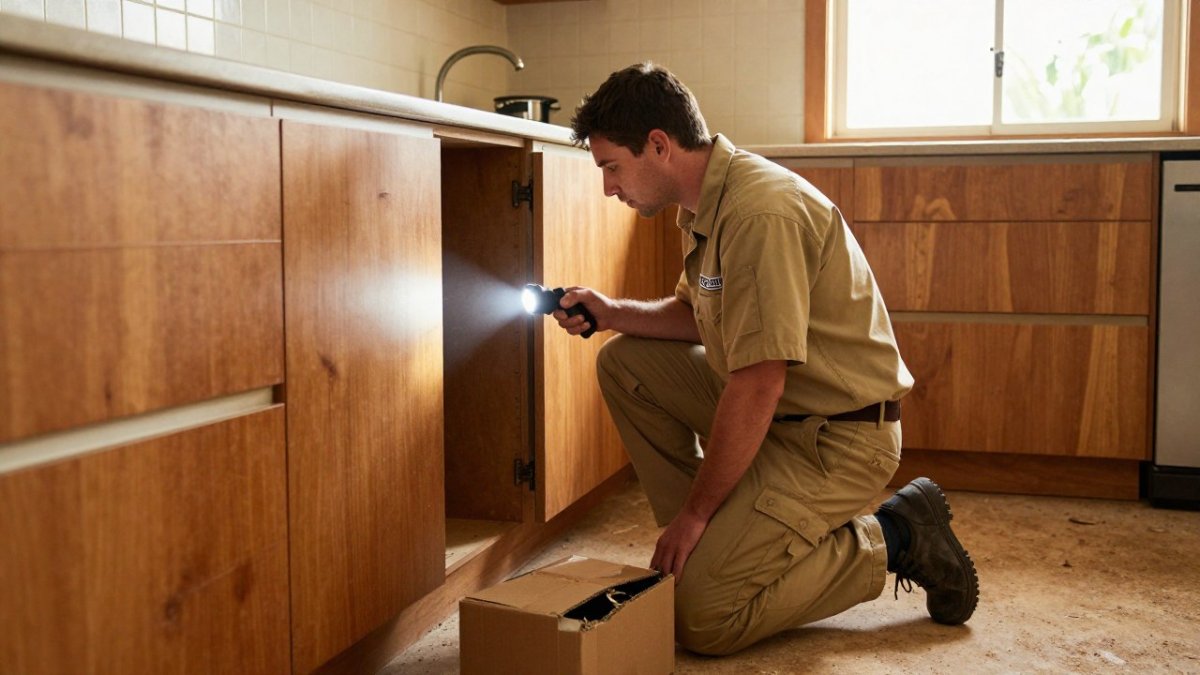
A commercial pest inspection is a structured site audit that maps pest activity, entry points and risk areas across the whole property. It should produce a written report you can hand to a facility manager, auditor or insurer.
Work through this checklist with your provider:
- Perimeter walk: gaps, weep holes, drainage and vegetation against walls
- Entry points: doors, roller shutters, loading docks and service penetrations
- Food and waste zones: bins, grease traps, prep benches and dry storage
- Moisture sources: leaks, condensation and poorly drained areas
- Harbourage: cluttered storerooms, ceiling voids and equipment backs
- Monitoring stations: placement, condition and activity recorded
- Previous treatment history and any recurring hot spots

What a Site Audit Should Cover
Every zone of the building, not just the obvious ones. A proper audit documents activity levels, photographs findings, and ranks each area by risk profile so you know where to spend first. If a provider walks the kitchen and leaves without checking the roof void and service corridors, the report is incomplete.
Integrated Pest Management for Commercial Buildings
Integrated pest management for commercial buildings is a prevention-first approach: eliminate food, water and shelter, then use targeted treatment only where monitoring shows activity. It reduces chemical reliance and keeps results steadier across the year.
In practice, that means sanitation fixes, pest exclusion through sealing and screening, scheduled monitoring, and treatment applied to specific hot spots rather than blanket spraying. For a hospitality venue or holiday rental, this also limits disruption to guests.
The approach matters in the tropics because pests rebound fast. Prevention removes the conditions that let a population rebuild after a treatment, which is why the ants keep coming back when a provider only sprays.
How Often? Commercial Pest Control Frequency Explained
Commercial pest control frequency depends on your risk profile, not on a standard package. High-risk sites such as commercial kitchens and food retail typically need monthly service; lower-risk offices can often run quarterly. Every site should include monitoring between visits, because the interval between services is where problems either get caught early or get out of hand.
| Site Type | Typical Frequency | Why |
|---|---|---|
| Commercial kitchen, food retail | Monthly | High pest pressure, audit exposure |
| Hospitality and holiday rentals | Monthly to quarterly | Guest complaints, fast response needed |
| Warehousing and logistics | Quarterly | Loading dock and storage risk |
| Offices and retail | Quarterly | Lower risk, monitoring focus |
What Actually Drives the Interval
Four factors move a site up or down the schedule, and a provider should be able to name which ones apply to yours:
- Pest pressure from the surrounding environment. A site backing onto drainage reserves, food premises or dense vegetation will always run hotter than an isolated office park. Heat and humidity keep pressure high year-round, so a single treatment rarely holds through a full season.
- Building condition and exclusion quality. Gaps at service penetrations, ill-fitting roller shutters and unsealed loading docks give pests a permanent invitation. Until those are fixed, the frequency has to compensate.
- Activity history. A site with recurring hot spots, the same storeroom, the same ceiling void, needs a tighter cycle until the underlying cause is removed, not just treated.
- Audit and contractual obligations. Food businesses and sites with insurer or landlord requirements often have a mandated minimum service interval written into their agreements. The schedule has to satisfy that document, not just the pest count.
Monitoring Between Visits
The interval matters less than what happens inside it. A proper program places monitoring stations at fixed points, records activity at each visit, and uses that record to decide whether the next service is routine or targeted. Without that record, frequency is guesswork and you cannot demonstrate due diligence when an auditor or insurer asks.
Watch out: a provider who quotes a frequency before walking the site is selling a package, not a program. The interval should follow the audit, not precede it.
Season and building condition shift this. A site with ongoing drainage issues or open loading docks may need a tighter maintenance schedule until the underlying problem is fixed, then can step back down once exclusion work is complete and monitoring shows a clean cycle.
Commercial Pest Control Provider Checklist: How to Choose
Choosing a provider comes down to evidence. Ask for licensing, insurance, a written scope, reporting samples and response times, then compare answers side by side.
- Confirm current licensing and insurance for every technician who will attend
- Request a sample pest activity report and service level agreement
- Ask what happens between scheduled visits, and how fast emergency response is
- Check they offer discreet service for guest-facing and customer areas
- Confirm the treatment approach and what products are used
- Get clear contractual obligations, including notice periods
For a deeper set of questions to put to any provider, our guide on how to choose local pest control walks through the comparison.
Preventative vs Reactive: The Cost-Benefit
Reactive call-outs can stack up through emergency attendance, stock loss, disrupted trading and repeat treatments for the same problem. A scheduled program can spread cost more predictably and catch activity earlier. The trade-off is commitment, since the value generally shows over a full cycle.
Compliance, Safety and Sustainable Pest Control
Compliance is where cheap pest control gets expensive. Commercial sites carry obligations around workplace safety, food handling and record keeping, and an auditor will ask for treatment records, not assurances.
Ask any provider how they document pest activity reporting, what environmental safety measures they follow, and whether non-toxic solutions form part of the program. Sustainable pest control is not a marketing line; it is the practical outcome of prevention-first work, and it matters when guests, staff and customers share the space. Our commercial and holiday rental plans set out scheduled services and reporting for exactly this reason.
Book Your Commercial Pest Audit
The gap between a compliant building and a pest problem is usually a schedule nobody followed. If your current program is reactive, undocumented, or you cannot produce a report when asked, that is the signal to change.
Tropic Shield Pest Services provides licensed technicians and eco-conscious treatments built for the tropical climate. We are locally owned and operated.
Get started with Tropic Shield Pest Services and put a documented, scheduled program in place before the next inspection. Get in touch for current prices or a quote.
A commercial building with no pest records is a building waiting for a bad audit. We can fix that with a scheduled program, clear reporting and technicians who turn up when they say they will. Get started with Tropic Shield Pest Services and protect your asset year-round.
Frequently Asked Questions
What should commercial pest control include?
A proper commercial pest control service should include a documented site audit, a written risk assessment, treatment of active pests, and a monitoring plan for the months between visits. Ask for pest activity reporting after every visit, a service level agreement that sets response times, and clear records you can show during a health inspection. Prevention matters as much as treatment: exclusion work, sanitation advice and scheduled inspections stop infestations recurring rather than just clearing what is visible on the day.
How often should a commercial building be inspected for pests?
Commercial pest control frequency depends on your risk profile, not a single rule. High-risk sites such as commercial kitchens, food retail and hospitality venues usually need monthly service and monthly monitoring checks. Lower-risk offices and warehouses can often run on a quarterly maintenance schedule. Any site with previous termite activity, shared walls or heavy deliveries should be inspected more often. Build the frequency into your service level agreement so it is reviewed rather than assumed.
What is integrated pest management for commercial buildings?
Integrated pest management for commercial buildings is a prevention-first approach. It starts with a site audit to identify entry points, harbourage areas and sanitation issues, then combines exclusion work, habitat removal, monitoring stations and targeted treatment only where pests are active. The aim is to reduce reliance on chemicals and stop infestations returning. Ask any provider how they apply IPM principles and what monitoring data they will share with your facility management team.
How do I choose a pest control company for a commercial building?
Work through a commercial pest control provider checklist: confirm current licensing and insurance, ask for experience in your industry, and request a sample pest activity report. Check whether they offer a written service level agreement with defined response times, transparent pricing before work starts, and a documented inspection process. A locally based operator who understands your building's climate and pest pressure is easier to hold accountable than a distant call centre, especially when you need same-day emergency response.