 Ultimate guide
How to Choose a Reliable Pest Technician
Last Updated: November 22, 2026
Quick Summary
Choose a reliable pest technician by verifying their licence number against your state regulator's public register, confirming insurance, and insisting on an inspection before any quote. Ask what will be applied, the re-entry times and the follow-up terms, and get the scope and price in writing before work begins.
- Run five checks in order: licence and insurance, pest-specific experience, inspection before quote, written scope, follow-up terms.
- A photographed licence card proves nothing, so confirm the number against the live register yourself.
- Quotes are only comparable when they cover the same scope, so rewrite each into the same structure first.
- A quote given over the phone with no site visit is a guess and a reason to walk away.
- Ask what happens if activity returns, who pays, and how quickly someone will attend.
Table of Contents
- What a Reliable Pest Technician Actually Looks Like
- How to Verify a Technician's Licence and Credentials
- Questions to Ask a Pest Control Company Before You Book
- What a Proper Pest Inspection Report Should Contain
- How to Compare Pest Control Quotes on Equal Terms
- Pest Control Treatment Safety for Families, Pets and Guests
- Treatment Methods, Products and Follow-Up Visits
- Red Flags and High-Pressure Sales Tactics to Walk Away From
- Book a Technician Who Puts the Checks First
- Frequently Asked Questions
What a Reliable Pest Technician Actually Looks Like
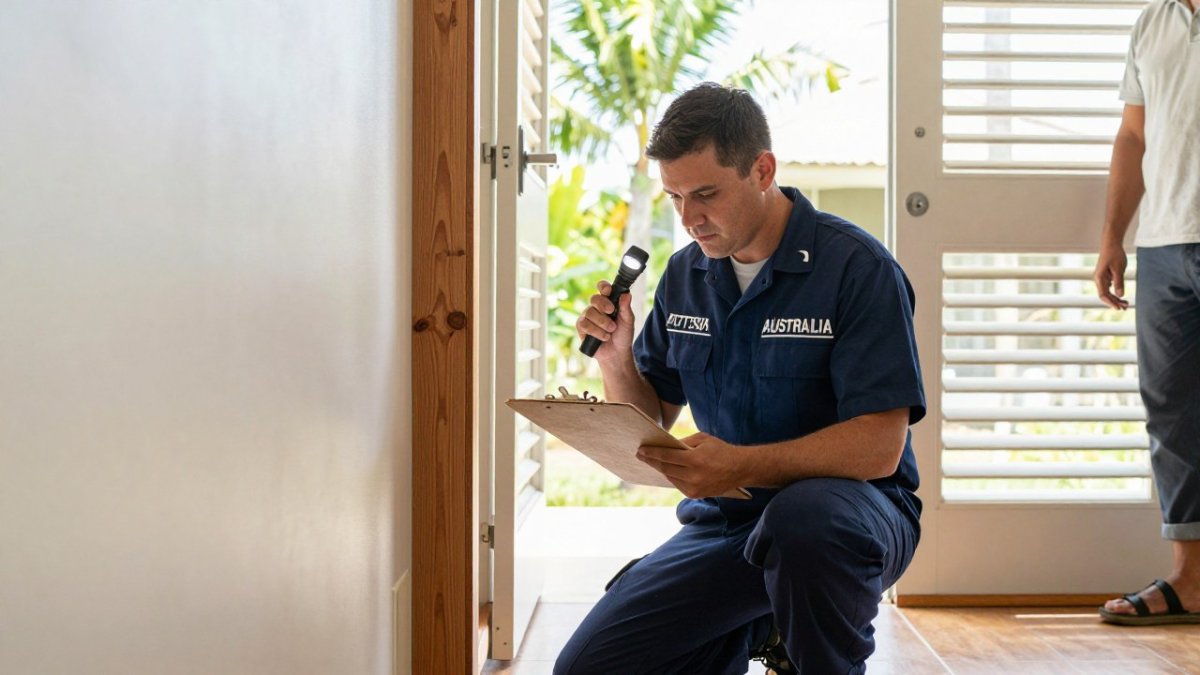
Choosing a reliable pest technician in the tropics is less about glossy brochures and more about proof. A good technician arrives licensed, inspects before spraying, explains what they found, and puts the plan in writing. A sound service is built around that sequence because it is the one homeowners, holiday rental managers and commercial operators can actually verify.
The difference matters in a climate where humidity keeps pressure on all year. A technician who treats a symptom without diagnosing the cause will be back next season with the same problem. Below, we walk through the five checks that separate a genuine professional from a salesperson with a spray tank, plus how to verify credentials, read a report, compare quotes and know what happens after treatment.
The Five Checks That Matter Most
Run these five checks in order before you book anyone:
- Licence and insurance. Ask for the licence number and confirm it independently.
- Pest-specific experience. Termite work and general household spraying are different skill sets.
- Inspection before quote. A price given over the phone without a site visit is a guess.
- Written scope and safety advice. You should know the products, the prep and the re-entry time before anyone starts.
- Follow-up terms. Ask what happens if activity returns, and get the answer in writing.
If you want the long version of this checklist, our guide on how to choose local pest control that works walks through the five questions to ask and how to compare services side by side.
How to Verify a Technician's Licence and Credentials
Verification is the step most homeowners skip, and it is the cheapest protection you have. Pest management businesses and technicians are generally expected to hold the licences required by their state or territory regulator, and those requirements vary by jurisdiction. Ask for the licence number and the name it is registered under, then check it against the relevant state register rather than accepting a photo of a card.
How to run the check, step by step
- Get the details in writing before the visit. Ask for the business name as registered, the trading name, the licence or registration number, the name of the technician who will attend, and a certificate of currency for public liability insurance. A legitimate operator supplies these without hesitation.
- Open the regulator's public register for your state or territory. Each jurisdiction maintains its own lookup, so search for the current official register rather than relying on a link saved years ago. Registers are usually searchable by licence number, business name or individual name.
- Match the entity, not just the number. The licence should belong to the business quoting you, or to the individual attending. A number that belongs to a different company, a former trading name or a sole trader who is not on the job is a mismatch worth questioning.
- Check status and scope. Confirm the licence is current, not suspended or expired, and that the class of licence covers the work being sold. Some licence classes cover only part of the work on offer, so check that the licence covers the specific work being sold.
- Check the expiry date against your booking date. A licence that lapses before your treatment date is not valid for the job.
- Confirm insurance separately. A licence is not insurance. Ask for the certificate of currency and check the policy is current and the insured entity matches the business you are hiring.
What the register will and will not tell you
A public register confirms that a licence exists, who holds it, what it authorises and whether it is in good standing. It will not tell you whether the technician is careful, thorough or good with customers. That is why the licence is the floor, not the ceiling: it gets a technician through the door legally, and the questions you ask next determine whether the job is done properly.
Watch out: a photographed licence card proves nothing on its own, cards can be old, cancelled or belong to someone else, so always confirm the number against the live register yourself.
Credentials worth confirming beyond the licence
- Public liability insurance, with a certificate of currency on request
- Competency in the specific treatment being sold, particularly termite management
- Membership of a recognised industry association
- Written confirmation of who will actually attend, and that person's licence details
If a company cannot or will not give you the licence number and the registered name before you book, treat that as an answer in itself.
Questions to Ask a Pest Control Company Before You Book
The right questions to ask a pest control company fall into four groups: who attends, what they will do, what they will use, and what happens afterwards. Ask them before you commit, and note whether the answers are specific or deflected.
Try these:
- Who will attend, and what licence do they hold?
- Will you inspect before quoting, and is the inspection report included?
- Which pests are covered, and which are excluded?
- What products will you use, and what are the re-entry times?
- Do you offer a follow-up visit, and under what conditions?
- Can I have the scope of work and price in writing before you start?
A company that answers these clearly and without pressure is usually a company that documents its work. Vague answers about "a general treatment" or "whatever is needed on the day" are your cue to keep looking.
What a Proper Pest Inspection Report Should Contain
A proper pest inspection report documents what the technician observed, where, and what it means, not just what was sprayed. For a general treatment, expect a summary of activity by area, the species identified, the treatment applied and any conditions that will invite reinfestation. For termite work, the report should record the inspection scope, any evidence found, and the recommendations.
At minimum, the report should include:
- Date, property address and the name and licence number of the inspector
- Areas inspected and areas that could not be accessed
- Pest identification and evidence observed, with locations
- Treatment method, products used and any safety instructions
- Recommendations for prevention and the date of the next recommended inspection
If a report is a single line saying "treated for pests", you have not received a report. If you are unsure what a standard service visit involves, our breakdown of what to expect during a general pest spray service explains the sequence so you can check the report against it.
How to Compare Pest Control Quotes on Equal Terms
Quotes are only comparable when they cover the same scope, so line them up before you look at the total. A cheaper quote that excludes the inspection, the follow-up visit or termite-specific work is not cheaper; it is a smaller job.
Normalise the quotes first
Before comparing totals, rewrite each quote into the same structure. Take a blank sheet and, for every quote, record the same fields in the same order:
| What to Compare | Why It Matters | What Good Looks Like |
|---|---|---|
| Inspection included | Confirms diagnosis precedes treatment | Site visit and written findings before pricing |
| Pests covered | Defines the actual scope | Named pests, named exclusions |
| Treatment areas | Prevents internal-only versus full-perimeter confusion | Rooms, boundary, roof void and subfloor stated |
| Treatment method | Drives both results and risk | Method matched to the species found |
| Products and safety | Affects family, pets and guests | Products named, re-entry time stated |
| Follow-up terms | Shows confidence in the work | Follow-up visit or warranty in writing |
| Exclusions and add-ons | Reveals the real cost | Every exclusion listed, not buried in terms |
| Total price and inclusions | Prevents surprise charges | One written figure, no add-ons after the fact |
Worked example: why the headline price misleads
Suppose one quote covers a general internal and external spray with a single follow-up visit if activity returns, and another covers internal treatment only, with the perimeter, roof void and subfloor priced as extras. On paper the second may look lower. Once you add the excluded areas and the follow-up, the gap usually narrows or reverses. The lesson is not that one is always better, it is that you cannot rank them until every quote is expressed in the same units.
Questions that expose the real scope
- Which areas are treated, and which are explicitly excluded?
- Is the inspection and written report included, or charged separately?
- Is the follow-up visit included, and what triggers it?
- Are there call-out fees, after-hours fees or charges for a second visit?
- What is the warranty period, and what voids it?
- Is the price fixed once work begins, or can it change on the day?
When quotes differ in scope
If two quotes cover genuinely different work, do not average them. Ask each provider to re-quote against the same scope, in writing, so the comparison is like for like. A provider who will not put the scope in writing is telling you something useful.
Watch out: a very low quote can reflect a smaller job rather than a better price, check what has been left out before you treat it as the bargain.
For a broader view of how providers and treatment options stack up, our comparison of affordable pest control services in Cairns puts providers and inclusions side by side so you can judge quotes on the same footing.
Pest Control Treatment Safety for Families, Pets and Guests
Pest control treatment safety comes down to three things: what is applied, how the site is prepared, and when it is safe to return. Ask for all three in writing before the technician starts, and follow the preparation instructions exactly.
Practical steps that reduce risk:
- Clear food, utensils and pet bowls from treated areas before the visit
- Cover or remove bedding, toys and pet enclosures in rooms being treated
- Keep children and pets off treated surfaces until the stated re-entry time has passed
- Ventilate the property as directed once the technician finishes
- Ask which products are being used and keep the label information on file
For families with young children, pets or holiday guests arriving soon, the detail matters more than the headline. Our guide on pet and child safe pest control covers low-toxicity methods, preparation steps and re-entry timing in full, and it is worth reading before you confirm a booking.
Treatment Methods, Products and Follow-Up Visits
Treatment methods should follow the diagnosis, not a standard script. A technician who reaches for the same product regardless of what they found is not practising pest management; they are running a routine.
Broadly, expect a mix of chemical and non-chemical measures. Non-chemical steps include sealing entry points, removing food and water sources, and correcting moisture or timber conditions that invite pests. Chemical treatment should be targeted to the species and the location, with the product and application method recorded in your report. Integrated pest management, where prevention and monitoring sit alongside treatment, is a widely used approach.
Follow-up is where reliability shows. Ask directly: if activity returns within the stated period, what happens, who pays, and how quickly will someone attend? Put the answer in writing. A service guarantee is only worth what the terms say it is worth.
Red Flags and High-Pressure Sales Tactics to Walk Away From
Pressure is the clearest signal something is wrong. Legitimate pest management is a diagnostic service, and a technician who has not inspected your property cannot honestly tell you what it needs.
Walk away when you see:
- A quote given over the phone with no site visit
- Urgency framing that demands a signature on the spot
- A price that changes after the work begins
- No licence number, no insurance, no written scope
- A refusal to name the products being used
- A "free" inspection that turns into a same-day ultimatum
The one that catches people most often is the discounted price for signing today. Reputable operators will still be there tomorrow at the same price, because the price reflects the work, not the sales pressure.
Book a Technician Who Puts the Checks First
The standard is simple: licensed, insured, inspection-first, written scope, documented products, and follow-up terms you can hold them to. Everything else is marketing.
At Tropic Shield Pest Services, our licensed technicians deliver safe and eco-friendly treatments for homes, holiday rentals and commercial properties, and we are locally owned and operated. If you are ready to move from checking to booking, call or email our team and we will talk you through the next step.
The gap between a good pest outcome and a recurring problem is almost always the quality of the technician, not the strength of the chemical. Hold every provider to the same five checks and the decision becomes straightforward. Get started with Tropic Shield Pest Services and book a licensed technician who inspects first, documents the work and stands behind the result.
Frequently Asked Questions
How do I know if a pest technician is qualified?
Ask for the technician's licence number and check it against the state licensing register before work starts. A qualified pest technician holds a current licence, carries insurance, and can explain which pests they are trained to treat. Ask how long they have worked in tropical conditions, because humidity and seasonal pressure change how treatments perform. A reliable operator will hand over these details without hesitation and put the scope of work in writing.
What should I ask a pest control company before booking?
Ask five things: who holds the licence and what it covers, what the inspection includes, which treatment methods and products will be used, what safety precautions apply to children and pets, and what happens if pests return. Also confirm response times and whether the quote is fixed. Write the answers down. A company that answers clearly and in writing is easier to hold to account than one that only talks on the phone.
How can I compare pest control quotes fairly?
Line up quotes on the same scope: same pest, same treatment area, same number of follow-up visits. Check whether each quote includes the inspection, the report, and a warranty period. A cheaper quote that skips the inspection or the follow-up is not cheaper, it is a smaller job. Ask each provider to state what is excluded so you compare like with like.
How do I know whether a pest control treatment is safe for my household?
Ask for the product name and the safety data sheet, and read the re-entry time before anyone returns to treated rooms. Tell the technician about young children, pets, asthma and anyone pregnant so the treatment plan can be adjusted. Follow the preparation and clearance instructions exactly. A technician who explains pest control treatment safety clearly, rather than brushing the question aside, is the one to book.
Should a pest technician provide a written report?
Yes. A pest inspection report should identify the pest, note where activity was found, describe the treatment applied and list what to watch for afterwards. It also gives you a record for warranties, rental compliance and future comparisons. If a technician cannot produce a written report, you have no evidence of what was done or what was promised.
What should I do before a pest technician visits?
Clear access to skirting boards, cupboards and the roof cavity, and move pets and children away from treatment areas. Empty lower kitchen cupboards if the technician asks, and cover food and utensils. Tell the company about any previous treatments so products are not mixed. Ask how long to stay out of the property afterwards, then follow that instruction rather than guessing.